Thursday, June 9, 2022

Saving Endangered Crafts: Introducing Heritage NL's Newest Batch of Mentor-Apprentice Participants

Mentor and apprentice pair Jennifer Morgan and Virginia Stoddart in Jennifer's printing studio. 

From birch brooms to beading, traditional skills at risk of being lost in Newfoundland and Labrador just got a boost from Heritage NL.

Twenty new projects from all across the province that pair a learner with an experienced craftsperson have been given the green light by Heritage NL, the provincial agency that deals with historic places and living heritage. This adds to a set of partnerships established earlier in the year.

The Heritage NL Mentor-Apprentice Program is a one-on-one immersion program that provides funding up to $10,000 to support the teaching of endangered crafts and skills from an established mentor to an apprentice craftsperson or tradesperson.

“The traditional craft sector is an important part of our contemporary economy, especially in rural areas,” says folklorist Dale Jarvis, Executive Director of Heritage NL. “We are excited to support these tradition bearers and entrepreneurs in learning and promoting skills and crafts that otherwise might fade away.”

The participants will have up to a year to work together, teaching and learning a variety of skills including spruce root basket making, blacksmithing, coopering, and sealskin work. Applications for this pilot program are now closed. For more information about the Heritage NL Craft at Risk List or Mentor-Apprentice Program see heritagenl.ca/programs/craft-at-risk/.

This program is supported by the Labour Market Partnerships program, Department of Immigration, Skills and Labour, Government of Newfoundland and Labrador.

The approved mentor/apprentice projects are as follows:

Beadwork
Mentor Bonnie Miller, Norris Arm North, with apprentice Starlynn Shears-Osmond, Grand Falls-Windsor.

Blacksmithing
Mentor Ian Gillies, Conception Bay South, with apprentice Sarah MacAulay, Mount Pearl;
and
Mentor Dennis Flood, Change Islands, with apprentice Timothy Penton, Joe Batt’s Arm.

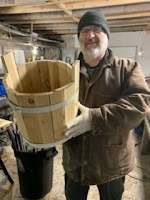
Coopering
Mentor Lester Cooper, Trinity, with apprentice Darren Hookey, Trinity.

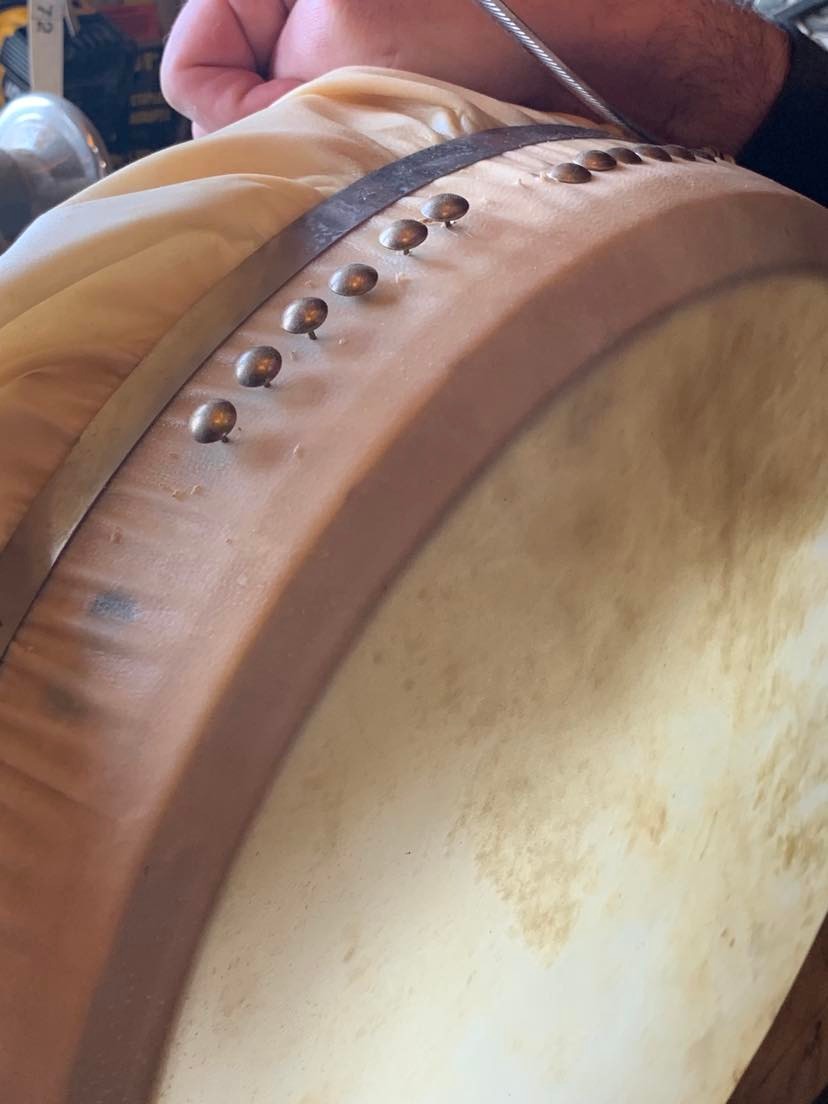
Bodhran making (Irish frame drum)
Mentor Paddy Mackey, Flatrock, with apprentice Bryan Poirier, St. John’s.

Komatik building (winter sled with runners)
Mentor Adam Greening, Port Blandford, with apprentice Joey Efford, Port Blandford;
and
Mentor Walter Fowler, Capstan Island, with apprentice Peter Fowler, South Branch;
and
Mentor Alfred Winters, Happy Valley-Goose Bay, with apprentice David Chaulk and Francine Winters, Happy Valley-Goose Bay.

Letterpress printing
Mentor Duncan Major, St. John’s, with apprentice Katie Butler Major, St. John’s;
and
Mentor Jennifer Morgan, St. John’s, with apprentice Virginia Stoddard, Bay Bulls;
and
Mentor Marnie Parsons, Tors Cove, with apprentice Abigail Hann, Port Blandford.

Mi’kmaq style moccasins
Mentor Loretta John, Conne River, with apprentice Kevin Drew, Conne River.

Millinery
Mentor Charlotte Reid, St. John’s, with apprentice Erica Dawe, St. John’s.

Running birch brooms
Mentor Richard Park, Gillams, with apprentice Michelle Park, Corner Brook.

Sealskin work including slippers and mittens
Mentor Barb Rumbolt, Mary’s Harbour, with apprentice Niki Greeley, Mary’s Harbour.

Spruce root basket making
Mentor Eileen Murphy, Corner Brook, with apprentice Sandi Yates, Gillams.

Weaving skills
Mentor Morgaine Parnham, Bonavista, with apprentice Sylvie Mitford, Bonavista.

Window/Door Making
Mentor David Winsor, Broad Cove, with apprentice Ben Marx, St. John’s.

Wriggle fence building
Mentor Guy Barnable, Ferryland, with apprentice Eric Escudero, St. John’s;
and
Mentor Jody Chaulk, Bloomfield, with apprentice Gracie Russell, Lethbridge.


For more information or photos, contact:

Dale Jarvis
Heritage NL
dale@heritagenl.ca
https://heritagenl.ca/programs/craft-at-risk/ 

Stay tuned to Heritage NL's social media for updates on our Mentor-Apprentice program!

Photo submitted by Niki Greeley.
Niki is an apprentice in sealskin work including slippers and mittens. 

Tacking the skin on a bodhran drum. Photo submitted by Paddy Mackey.
Paddy is a mentor for instrument making, specifically bodhran drums. 

Ian Gillies with an anvil in Rendell's Forge in Heart's Content.
Ian is a blacksmith mentor.

Thursday, April 28, 2022

Heritage NL Revitalization Grant - Pilot Project for community heritage projects involving Registered Heritage Structures


Heritage NL has redeveloped its restoration grant funding to better provide a suite of services to owners of Registered Heritage Structures. The Board is looking for projects that blend the restoration of a designated property with community planning workshops, architectural history research, and opportunities for transmission of traditional skills related to conservation of the site or the site’s history. The grant is intended to direct funding to projects that demonstrate community value as well as a need for material conservation. Project proposals in the $30,000 to $50,000 range will be considered, and successful projects will be funded on a 50/50 cost shared basis. In addition, grant recipients will work with Heritage NL staff to determine what other in-kind supports would benefit the project.


Example: The Salvage Fishermen’s Museum was approved for a grant for exterior restoration of the structure. In addition to the grant itself, Heritage NL worked with the local committee to: run a community People, Places, and Culture workshop; compile a comprehensive architectural history of the structure to aid in the conservation process; conduct research on family names and neighborhoods and develop a map; write a heritage report for the town with recommendations and suggestions for future work; teach a workshop on headstone digitization and facilitate a cemetery cleanup; assist with grant writing to help the museum hire a summer coordinator position; and work with the local committee to organize an official plaque unveiling ceremony at the end of their project.


Owners of any previously-designated Registered Heritage Structure may apply for restoration funding. An easement on the property must be in place to be eligible. Priority will be given to small to medium sized projects that:

  • Clearly demonstrate broad community involvement and support;
  • Will benefit from the provision of advice, research, and training from Heritage NL staff and the organization’s related training or Intangible Cultural Heritage programs;
  • Are located in areas that have been under-represented in previous grant cycles, including Western and Central Newfoundland, and Labrador;
  • Address or represent themes that have been under-represented in previous grant cycles, including Indigenous history, women’s history, and multi-ethnic heritage;
  • Represent outstanding examples of the built heritage of the Modern/Industrial period or agricultural sites;
  • Represent sites which include significant cultural landscapes as part of the designation.

Applications will be juried in a competitive process by the Board of Directors of Heritage NL. Funding is limited, and application does not guarantee funding. Approved grants are good for two years from the date of a signed Grant Contract agreement, and work must abide by the conditions of the Contract and follow the Standards and Guidelines for Conservation of Historic Places in Canada. Grants are paid following the successful completion of work and submission of a Final Project Report and all required documentation.


Deadline to apply: 27 May 2022

Wednesday, April 27, 2022

Historic Paint Colours of Newfoundland and Labrador Launch, April 28th


Heritage NL & Benjamin Moore Paint Shop Release Historic Paint Colours of Newfoundland and Labrador booklet.


Mount Pearl, NL (April 27, 2022) You are invited to attend a virtual launch of the Historic Paint Colours of Newfoundland and Labrador booklet.


Heritage Newfoundland and Labrador is proud to partner with the Benjamin Moore Paint Shop to present the Historic Paint Colours of Newfoundland and Labrador booklet. The Paint Shop is an NL company that has been in business for almost 50 years. With nearly 40 locations, the Paint Shop remains committed to growing in this province while continuing to expand into Atlantic Canada. Kerri Hodder, Marketing Manager with the Paint Shop, says, "This partnership with Heritage NL solidifies our commitment to being the keepers of the colours of Newfoundland and Labrador."


With locations in larger centres and some of our most historic communities like Twillingate and Bonavista, the Paint Shop was the natural choice to partner with for this booklet. 


Whether you are looking for Dorset Gold HC-8 to match your pop's dory buff or Watermelon Red 2087-20 to fit in on Jelly Bean Row, you'll find them all at the Paint Shop along with our Historic Paint Colours of Newfoundland and Labrador booklet.


The booklet will be launched via Zoom on Thursday, April 28th, 2022, at 3 pm.


Please click the link below to join the webinar:

https://tinyurl.com/HeritageNLPaint 


-30-


For information, please contact;


Kerri Hodder, Marketing Manager, Paint Shop 

kerri.hodder@thepaintshop.ca

&

Andrea O'Brien, Outreach/Provincial Registrar, Heritage NL 

andrea@heritagenl.ca


Tuesday, April 19, 2022

From horrid dogs to dangerous youngsters: telling back lane tales in Harbour Grace


Row of headstones in the Bennett's Lane Roman Catholic Cemetery.
Bennett's Lane is visible in the background. Photo taken: February 2022

Harbour Grace, NL -  From horrid dogs and dangerous youngsters, to casket makers and compassionate doctors, the back lanes of Harbour Grace have seen it all. The old stories of the laneways are coming to light once more, with a little help from graduate students enrolled in Memorial University’s Department of Folklore.

The project is a cooperation between students of FOLK6740: Public Folklore, the Town of Harbour Grace, and course instructor Dale Jarvis of Heritage NL. The idea emerged from discussions following a 2018 Heritage NL People, Places, and Culture workshop in the community.  The storytelling project focuses on the historic laneways and paths that run between many of the buildings within and bordering the town's Registered Heritage District.

Students Than Brown, Roshni Caputo-Nimbark, Meaghan Collins, Emma Kwok, Denise McKeown, and Anna Reepschlager interviewed locals, conducted archival research to uncover hidden tales, and created a wiki to document their finds. 

“This research project uncovered some fascinating information from both historical sources and residents’ memories,” says Matthew McCarthy, Economic Development Officer with the Town of Harbour Grace. 

“These areas are such treasure troves of stories, past and present,” says McCarthy. “We think there’s great potential to reanimate these footpaths for both residents and visitors through thoughtful public infrastructure.”

One of the laneways documented in the project is Doctor’s Lane, named in honour of the many early doctors who lived in Harbour Grace. This included Dr. William Stirling, born in Harbour Grace, who eventually settled in Twillingate. He and his wife, Anne Peyton, had ten children, the youngest of whom became Newfoundland’s first opera singer, Georgina Ann Stirling, “The Nightingale of the North.”

The back lanes, while under-developed today, invite exploration. 

“Right now, we have some significant private investment coming to the area, with Yellowbelly’s restorations of the old Courthouse and Immaculate Conception Cathedral,” says McCarthy, “and this project is another important piece of the municipality’s long-term plan to revitalize the downtown Registered Heritage District. We’re excited with where things are headed.”

The students’ wiki page is viewable at:

https://en.wikiversity.org/wiki/Laneways_of_Harbour_Grace 


Monday, April 18, 2022

Job Posting for Built Heritage Intern with Heritage NL


Heritage NL is a non-profit organization that promotes the conservation and awareness of Newfoundland and Labrador's historic places and the safeguarding of its Intangible Cultural Heritage. 

Heritage NL is seeking a qualified individual for the position of Built Heritage Intern to undertake a number of projects that will support the various programs of the foundation. These will include the development of short research papers on historical subjects, the rewriting of descriptive texts on designated properties, and the documentation of Registered Heritage Structures through field study, archival research, and oral histories. Eligible candidates should have an undergraduate or graduate degree in a relevant field such as: history; archaeology, folklore; architecture; cultural geography; archaeology or other related field. Candidates must meet eligibility requirements under the YCW program and be a resident of Newfoundland and Labrador. The job will be situated at the Heritage NL offices in downtown St. John's.

$20/hr, full time, ending March 31, 2023

Deadline to apply April 25, 2022

Apply directly though the Young Canada Works portal:

https://young-canada-works.canada.ca/Opportunity/Project?projectId=15174 

Thursday, April 7, 2022

Report released on Saving Traditional Skills on the Great Northern Peninsula


The Great Northern Peninsula Community Place Corporation and Heritage NL have been working together to make a list of people with traditional skills and know-how in the Tri-Town (Hawkes Bay, Port Saunders, and Port au Choix) area.

Local researcher Destiny Penney was hired to interview local crafters and seniors, and to compile a list of people in the region willing to share their skills. Her findings are summarized in a new report, released this week. 

The report features local knowledge-holders ranging from 85-year-old Edmund Alyward, a Port au Choix capelin net maker, to Hawkes Bay quiltmaker/sewer Josie Penney (shown above). 

"This will be an amazing resource for us to build on," says GNP Community Place Corporation's Joan Cranston. "I would like to identify people with traditional cooking skills as well, and traditional healing skills and knowledge."

The GNP Community Place is a community centre located on the main street of Port au Choix, NL. Overlooking the harbour, this community heritage building will offer a safe, accessible place for people from all over the Great Northern Peninsula to gather to participate in inter-generational health and wellness initiatives. It is run by a volunteer not-for-profit community corporation and operates as a social enterprise, offering space for programs to benefit the community while generating revenues to offset operating expenses

The full report can be downloaded in pdf format at: https://www.mun.ca/ich/resources/Saving_Traditional_Skills.pdf 

This project was jointly funded by Heritage NL and ICOMOS Canada’s Youth in Heritage Program.

Tuesday, April 5, 2022

Heritage NL announces updated funding program to help maintain Registered Heritage Structures


A cracked window or small leak in a roof might not seem like a big problem, but left unfixed, it can lead to major headaches for a homeowner. For owners of heritage properties, help is on the way to fix some of those small problems before they become big ones. 

Heritage NL has designated over 360 properties across the province as Registered Heritage Structures, a program which began in the early 1980s. Today, many of these iconic properties need some fixing-up. At a recent meeting of its Board of Directors, the organization agreed that the ongoing maintenance of heritage buildings is important, and needs to be a priority. 

“Deferred maintenance puts historic structures at risk of permanent damage or loss,” says Dr. Lisa Daly, Heritage NL Chair. “In the long run, the costs associated with regular maintenance of heritage features will be less than waiting to do large-scale repairs. On a practical level, it makes financial sense for Heritage NL to start addressing this now.”

In order to discourage deferring maintenance, and to encourage the continuous upkeep of designated properties, Heritage NL has streamlined and expanded their grant program. Structures designated by Heritage NL are now eligible to apply for a cost-shared grant of $3,000 every three years to assist with upkeep of exterior heritage features such as wooden windows, trim, and clapboard. 

The grant, while not large, is meant to help cover the gap between using less expensive repair options and proper restoration with the use of original materials.

Heritage NL has allocated a portion of its annual granting funds to cover this specific need, and owners of Registered Heritage Structures are encouraged to check the Heritage NL website for conditions and an application form


Thursday, March 31, 2022

Heritage NL celebrates barking and bark tanning as Distinctive Cultural Traditions and Practices.

Barking pots in Twillingate, early to mid 1900s. From the Twillingate Museum.


For Immediate Release

St. John’s, NL
March 31, 2022

Join us virtually on Tuesday, April 5, 7:00 pm as Heritage NL, with the support of The Rooms, celebrates barking and bark tanning as the newest addition to the Provincial Historic Commemorations Program’s list of Distinctive Cultural Traditions and Practices. The celebration will happen via Zoom. To register in advance for this webinar visit here.

Administered by Heritage NL, the Provincial Historic Commemorations Program (PHCP) commemorates provincially significant aspects of our history and culture. It is unique in that it also recognizes intangible aspects of our culture and heritage – the customs, cultural practices, traditional skills and knowledge that define our province and our people. Since the Program's inception in 2010, 39 designations have been made, including the designation being recognized on April 5th. 

Joan Ritcey, chair of the Commemorations selection committee, says, "the Provincial Historic Commemorations Program is an important element for the recognition and appreciation of our past. By recognizing our cultural traditions and history we honour our heritage and pass it on to future generations."

The tradition of bark tanning and the use of bark mixtures has a long history in Newfoundland and Labrador. The old iron bark pot on the landwash was (and is) a reminder of our ancestors’ skills. Bark was used by Indigenous peoples and settlers alike for tanning hides, making fishing nets more durable, and colouring everything from sails to clothing. 

Today, the old tradition of barking is finding new life as craftspeople embrace this ancient technique. A representative from the Labrador Artisans Co-op and participants in Heritage NL’s Crafts at Risk Mentor/Apprentice Program will be joining us to discuss current barking projects. Follow this link to the official Commemoration listing .

###                                                                       

For Further Information Contact:

Andrea O’Brien
andrea@heritagenl.ca  
1-888-739-1892 ext 4


Saturday, March 26, 2022

Living Heritage Podcast Ep217 Weaving Her Life Across Canada

Weaving and hooked rugs by Celeste Colbourne.

In this episode of the Living Heritage Podcast we talk with Celeste Colbourne about weaving including her interest and background with the craft, the process of weaving, and her experience weaving across Canada.

Celeste Colbourne in front of her loom in her home.

Celeste Colbourne is a weaver who was introduced to the intricacies of making yarn, threading a loom, and creating beautiful cloth 28 years ago in British Columbia. Over the years miles of handwoven cloth have been woven and sold in almost every province, and now she is home, weaving in Newfoundland.

###

Living Heritage is about people who are engaged in the heritage and culture sector, from museum professionals and archivists, to tradition bearers and craftspeople - all those who keep history alive at the community level. The show is a partnership between HeritageNL and CHMR Radio.

Theme music is Rythme Gitan by Latché Swing.


Friday, March 18, 2022

Living Heritage Podcast Ep216 Bunches of Barrels with Lindy Rideout


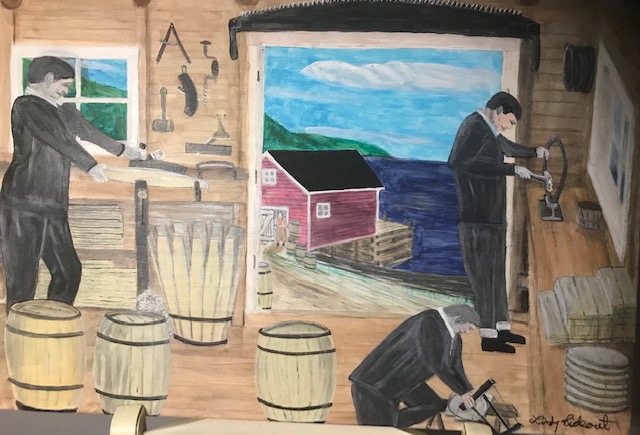
In this episode we talk about Lindy's experience learning coopering or barrel making, the traditional and modern tools used, and the importance of cooperage to Cottlesville. We also discuss the historical uses for barrels as well three different grades of barrel making.
Lindy Rideout holding one of his pieces. 
Lindy Rideout is a self trained cooper who lives in Cottlesville, New World Island, NL. Using his grandfather’s cooperage tools he has made barrels, water buckets, and even a wooden hot tub. A third generation boatbuilder who builds kayaks he has also taken up painting and has tried to capture the work of barrel making including the tools, process, and people.

Coopering or barrel making is one of the crafts listed in the Heritage NL Craft at Risk List 2021


Painting completed by Lindy Rideout.

###

Living Heritage is about people who are engaged in the heritage and culture sector, from museum professionals and archivists, to tradition bearers and craftspeople - all those who keep history alive at the community level. The show is a partnership between HeritageNL and CHMR Radio.

Theme music is Rythme Gitan by Latché Swing.

Thursday, March 10, 2022

Municipal Designation of Cemeteries - a How-To session with Heritage NL


Thursday, March 24, 2022
2:00 PM

Cemeteries throughout Newfoundland and Labrador are generally revered as special, sacred places. They occupy both emotional and physical space in our communities. Cemeteries are also expressions of our spiritual beliefs and cultural values, as well as rich repositories of genealogical and community history. 

Under the Municipalities Act, incorporated Newfoundland and Labrador municipalities can create Heritage Advisory Committees and designate locally important heritage buildings, structures and lands. In this free webinar, Heritage NL outreach officer Andrea O’Brien will walk you through the steps of how municipalities can designate cemeteries that fall within their town limits, and will explain what that means in terms of the protection of cemeteries as a historic resource. 

Register at:

https://us06web.zoom.us/webinar/register/WN_j3FCItadRLuex16IG0l2VA


Wednesday, March 9, 2022

Heritage NL celebrates Outport Girls and Women in Domestic Service as Exceptional People from the Past.


Unknown woman and Monica Rice Rossiter, Nunnery Hill, St. John's, circa 1930s.

The newest addition to our Provincial Historic Commemorations Program (PHCP) honours Outport Girls and Women in Domestic Service as Exceptional People from the Past. 

The PHCP (administered by Heritage NL) commemorates provincially significant aspects of our history and culture. It is unique in that it also recognizes intangible aspects of our culture and heritage – the customs, cultural practices, traditional skills and knowledge that define our province and our people.

Joan Ritcey, chair of the Commemorations selection committee, says, "the Provincial Historic Commemorations Program is an important element for the recognition and appreciation of our past. By recognizing our cultural traditions and history we honour our heritage and pass it on to future generations."

Since the Program's inception in 2010, 38 designations have been made, including the designation being recognized on March 8th:  Outport Girls and Women in Domestic Service (Exceptional People from the Past).

The economic history of Newfoundland and Labrador is dominated by prominent merchants, politicians and businessmen. But merchant and fishing households alike could not have operated without the help of “the girl”: that is, the domestic servant. These girls and young women, usually from rural outports, represented the largest sector of waged women’s work from the late 19th century right up to Confederation. Their often invisible labour was essential to the operation of households of all classes. The migratory workforce of outport women in this province was a key part of the Newfoundland and Labrador economy up until the 1950s, and an important part of its social history. 

Follow this link to the official Commemoration listing https://heritagenl.ca/discover/provincial-historic-commemorations-program-designations/outport-girls-and-women-in-domestic-service.

Heritage NL is a provincial crown agency with a mandate to stimulate an understanding of and an appreciation for the architectural heritage and intangible cultural heritage of the province. For more information visit www.heritagenl.ca.

For Further Information Contact:

Andrea O’Brien                                                                                             
andrea@heritagenl.ca                                                 
1-888-739-1892 ext 4 

Tuesday, March 8, 2022

If you've ever wanted to learn how to make traditional barrels, this is your big opportunity!

Constructing an oak wine barrel at French cooperage


EXPRESSIONS OF INTEREST

are being sought for a

Seasonal - Continuing Employment Opportunity with

Trinity Historical Society Inc.

as a COOPER/MUSEUM SUPERVISOR

for up to sixteen weeks (potentially longer) at 35 hrs/wk.

Trinity Historical Society is seeking expressions of interest from individuals who are interested in becoming the Cooper/Museum Supervisor at our Cooperage in Trinity.

Trinity Historical Society will provide orientation and training to the position in Trinity and potentially out of province (possibility of Ross Farms, Nova Scotia).

You will be expected to sign a contract of seasonal employment with the Society for a minimum of three years; provide demonstrations in barrel making and making a barrel and other products made of wood at the historic site for sale for the Historical Society; provide interpretation on the trade and history of the Cooperage to visitors; supervise one or two students during the summer and oversee the day-to-day operations of the historic site.

Education, Experience and Training:

You are a mature individual with graduation from high school and some carpentry and/or woodworking experience; you have excellent communication skills and are comfortable in communicating with individuals and groups; you are highly organized, self motivated and creative and possess a knowledge of and interest in the history of Trinity and area, of Newfoundland and Labrador and of coopering (wood work); you must be pleasant and outgoing, capable of working on your own as well as with others and have some prior experience in dealing with the public.

A valid driver’s license, use of a private motor vehicle and First Aid would also be an asset but not necessary. Any prior experience with general or heritage carpentry will be considered an asset but not necessary for application. Should you have any wood working experience the provision of some pictures of our work would be appreciated with your submission.

Salary and Benefits:

Starting salary to be determined based on work experience and negotiable. Benefits include vacation allowance to 4% of bi-weekly pay, Workplace, NL premium and payment of the employer’s share of Mandatory Employment Related Costs for Canada Pension Plan and Employment Insurance Premiums.

Additional information or any questions please contact us 464-3599 or e-mail: ttci@nf.sympatico.ca.

Applications will be screened and successful applicants will be interviewed prior to selection. Please mail or e-mail your cover letter, resume and references to:

Trinity Historical Society Inc.

P.O. Box 8 Trinity, NL A0C 2S0

Fax: (709) 464-3599 e-mail: ttci@nf.sympatico.ca

Deadline: 4 PM Friday, March 18, 2022


Monday, March 7, 2022

Intangible Cultural Heritage - the Laurentic Forum on Sustainable Tourism Webinar, March 15th.


Intangible cultural heritage refers to the traditions or expressions we practise inherited from our ancestors and passed onto our descendants, such as ceremonies and oral traditions. In other words, it is a living form of heritage that is continuously recreated by communities as part of their cultural identity. From storytelling to dancing, traditional crafts to how we live our lives there are many elements of our culture that are of interest to visitors to our regions. By presenting them to the visitor we not only provide opportunities to make a living from tourism but in sharing it, we may be able to preserve it.  

Keynote by folklorist Dale Jarvis, Executive Director of Heritage NL, with presentations from: the Wooden Boat Museum of Newfoundland and Labrador; Lofotr Vikingmuseum; and Hasselberg Husky dog tours.

To register for this free webinar, go to:

https://storymaps.arcgis.com/stories/5140e3c9f29e4379ac8f5c7cbdf21634


Friday, March 4, 2022

Living Heritage Podcast Ep215 Dress Making, Millinery and More with Ellen Reid

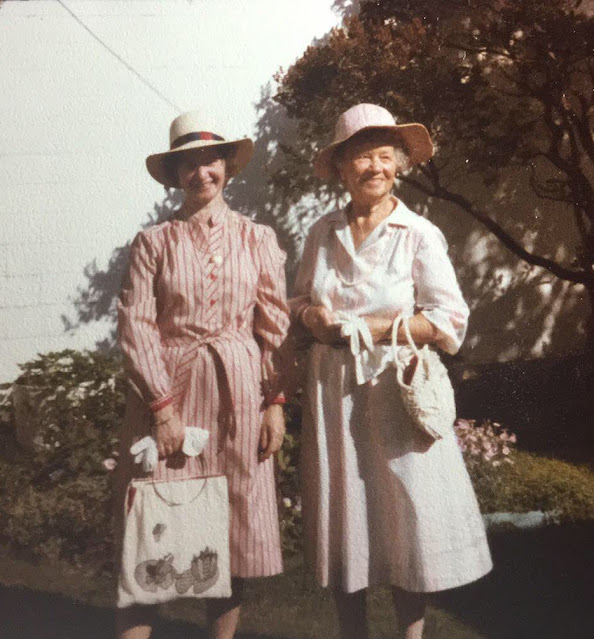
Phyllis Reid, and Irene Reid. Photo features embroidery by Phyllis, and hats by Irene.
Image courtesy of Ellen Reid.

In this episode we talk about Ellen’s grandmother Irene Reid along with several other family members' experience with millinery, dress making, knitting, embroidery, and other textile work. We also touch on Ellen's experience with the wool stall at the Anglican Cathedral, and some of the work of the St. John's Guild of Embroiderers.

Ellen Reid has been contributing to the local arts scene for over 30 years. A poet, playwright, visual artist, a blogger and an arts patroness! She is a grateful and frequent contributor to the Cosmic Show! She has been an early childhood educator for 20 years.

###

Living Heritage is about people who are engaged in the heritage and culture sector, from museum professionals and archivists, to tradition bearers and craftspeople - all those who keep history alive at the community level. The show is a partnership between HeritageNL and CHMR Radio.

Theme music is Rythme Gitan by Latché Swing.


Tuesday, March 1, 2022

Heritage Properties, Exceptional Women, Ice Cutting, and more! The March 2022 Heritage Update


In the March 2022 Heritage Update: Heritage NL designates four properties as Registered Heritage Structures; Outport Girls and Women in Domestic Service to be recognized as Exceptional People from the Past; the hunt for a mill basket maker; Ice Cutting and Salmon Fishing; and the New Perlican Scanning and Technology Party!

Download the pdf 

Friday, February 18, 2022

Living Heritage Podcast Ep214 Repair and Restoration with Rex Passion


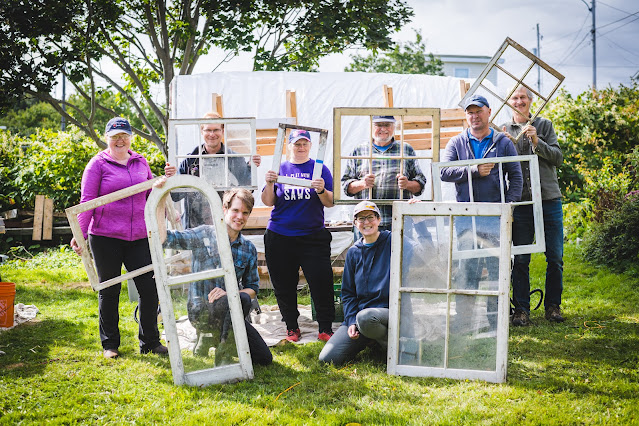
Participants of wooden window workshop led by Rex Passion. 
Rex is the fourth person from the right standing up. 
Photo by Harnum Photography.
In this episode of the Living Heritage Podcast we talk with Rex Passion about historic restorations and repairs. Rex describes his background, what brought him to Newfoundland, his work on Kent Cottage, and leading workshops and demonstrations to teach traditional skills. Rex apprenticed as a cabinetmaker and carpenter in California and Boston in the 1970s. In 2006 he sold his construction company and architecture firm, Classic Restorations, and subsequently moved to Torbay. His vocation of restoring old houses became his avocation, heritage preservation. He currently sits on the Landfall Trust Board of Directors, and recently taught a wooden window repair and restoration workshop with Heritage NL.

###

Living Heritage is about people who are engaged in the heritage and culture sector, from museum professionals and archivists, to tradition bearers and craftspeople - all those who keep history alive at the community level. The show is a partnership between HeritageNL and CHMR Radio.

Theme music is Rythme Gitan by Latché Swing.


Saturday, February 12, 2022

Ice Cutting and Salmon Fishing in Newfoundland and Labrador


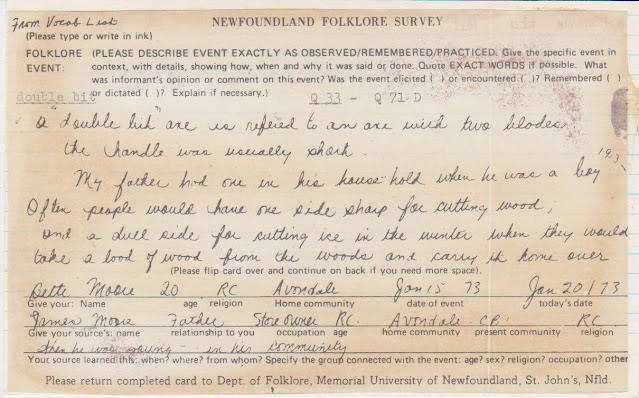
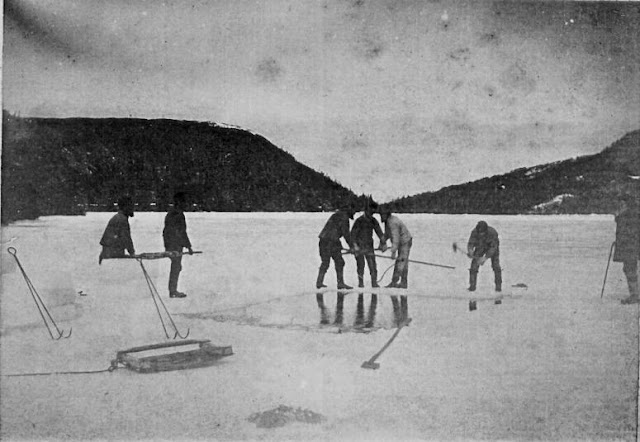
In the twentieth century, the salmon fishing industry was intertwined with many other industries. It was common practice for fishermen to cut blocks of ice from frozen ponds in the winter using various types of saws (Figure 1) and store them in sawdust to later use in transporting their freshly caught salmon to merchants when the fishing season opened. Sawdust was an abundant byproduct from sawmills and acted as an insulating layer for ice which prolonged the use of ice well beyond the cold winter months. This made ice cut from ponds in the winter accessible in May and June when the salmon fishery opened.


Figure 1: Image reads: a "double bit" axe is referred to an axe with two blades, the handle was usually short. My father had one in his household when he was a boy. Often people would have one side sharp for cutting wood, and a dull side for cutting ice in the winter when they would take a load of wood from the woods and carry it home over. Image courtesy of Memorial University Digital Archives Initiative.

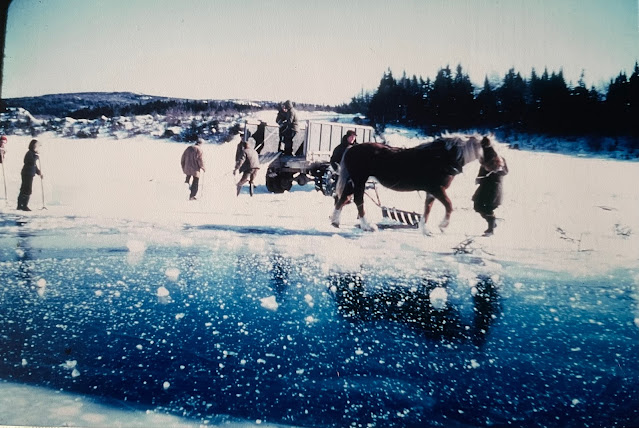
Once the ponds froze over, ice would be cut into large 18-20 inch square blocks using a pit saw and hauled by horse and sleigh to ice houses and sawmills to be unloaded into piles of sawdust (Figure 2, Figure 3). In Harbour Breton, ice from Beaver Pond was being cut out at nearly 20 dory loads per ice house. These ice houses were filled with sawdust and protected from sun exposure to ensure the preservation of ice for several months.


Figure 2: Ice cutting in Cape Broyle on Beaver Pond circa 1950s. Image courtesy of Andrea O’Brien taken from Mr. Ronald O’Brien’s collection.


Figure 3: Ice cutting in Gaultois, Newfoundland circa 1887 (Wells 2014).

In Whiteway, a community in Trinity Bay, several families such as the Burgess’, George’s, Legge’s, and Jackson’s, were operating sawmills while also salmon fishing in the summer and ice cutting in the winter.

Albert Legge has many memories of his family’s sawmill and their salmon fishing. Albert recalls an ice house located in New Harbour operated by a fish merchant named Ernest Woodman. Woodman, likely with the help of his sons, would also cut ice in the winter time and store it at his ice house until local fishermen had fish to sell which was then packed in ice and sent to markets. Likewise, Clifford George remembers an ice house in New Harbour that was built of boards into a large square area filled with sawdust where ice blocks were buried.

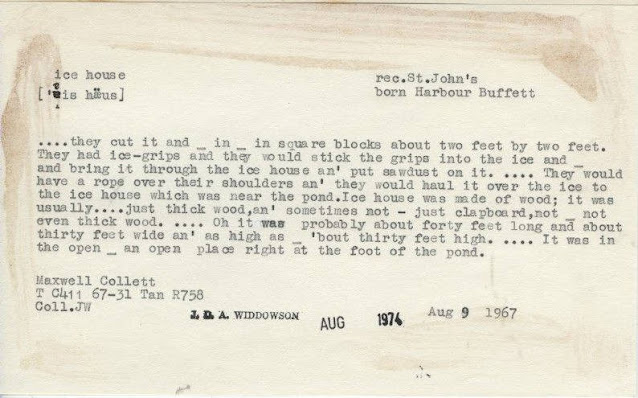
Legge remembers that in the 1950s there was an ice house owned by his family located on a pile of sawdust from their mill. The Legge’s did not cut ice themselves, instead they filled their ice house with ice from Woodman’s ice house in New Harbour. The ice from Woodman was delivered to their ice house by truck rather than horse. The ice was stored in the house in piles of sawdust (Figure 4) until May when the salmon fishery opened. Albert remembers that salmon were caught on a berth along the shore at a point called Salmon Point, which was the perfect spot to place a salmon trap. After catching their salmon, the fish would be cleaned and packed into wooden boxes filled with broken ice blocks before being shipped to New Harbour where it was then sent off to market.


Figure 4: Image reads: … they cut it and _ in _ in square blocks about two feet by two feet. They had ice-grips and they would stick the grips into the ice and _ and bring it through the ice house an' put sawdust on it. … They would have a rope over their shoulders an' they would haul it over the ice to the ice house which was near the pond.Ice house was made of wood; it was usually....just thick wood, an' sometimes not - just clapboard, not _ not even thick woods. .... Oh it was probably about forty feet long and about thirty feet wide an' as high as _ 'bout thirty feet high. .... It was in the open _ an open place right at the foot of the pond. Image courtesy of Memorial University Digital Archives Initiative.


Members of the Burgess family also have many memories of the family sawmill constructed in 1916, and their involvement with the salmon fishery. Robert Burgess recalls that his family would cut ice from Jimmy Rowe’s pond and then bury it in piles of sawdust at their sawmill. The Burgess’ sawmill is still intact on the property and the saws used to cut ice remain there. Robert recalled that:

Once the ponds froze over, the horse and sled would be driven across the pond in the morning, logs would be hauled out before lunch time, lunch was eaten and our uncles would change out the sweat-filled clothes, then head back across the pond to bring out more wood. This continued until the pond ice broke up in the spring.

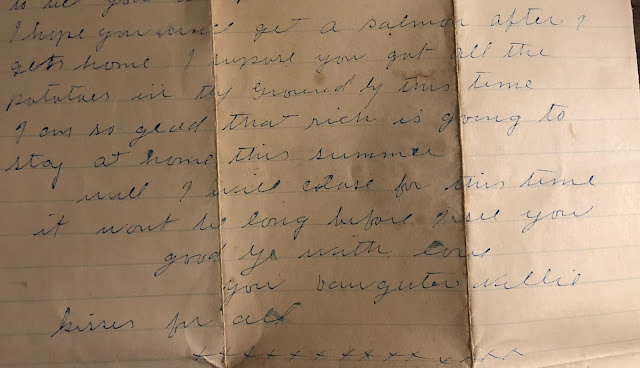
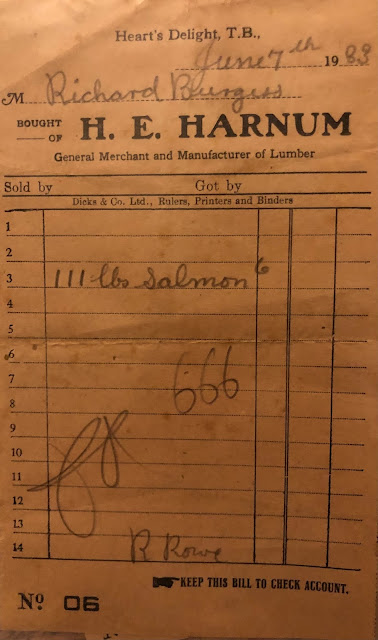
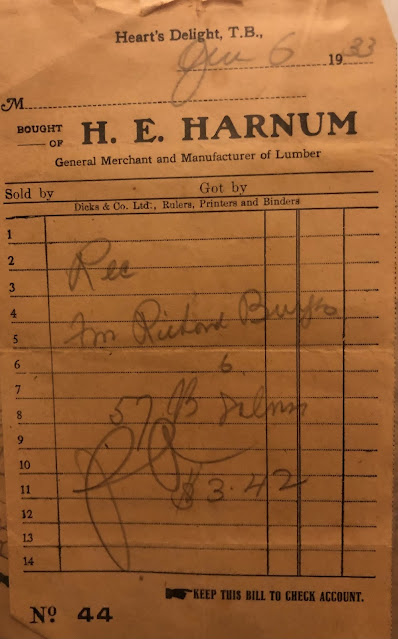
When salmon was caught in the bay months later, the ice blocks would be dug up and used to transport salmon to keep it fresh. The family also manufactured the boxes that they were shipping the iced salmon in. There are many memories of the family catching and selling salmon. In 1912, a letter from Great Aunt Nellie to Henry Burgess, Bob’s great-grandfather, sent in advance of her travels back home to Whiteway from the United States: “I hope you will get a salmon after I get home. I suppose you got all the potatoes in the ground by this time. I am so glad that Rich is going to stay at home this summer” (Figure 5). The Burgess family also used the ice they cut and preserved in sawdust to transport freshly caught salmon to merchant families such as the Harnum’s in Hearts Delight, Cramm’s in Green’s Harbour and the Moores in Carbonear, and many others (Figure 6,7).


Figure 5: Part of Great Aunt Nellie’s handwritten letter to Henry Burgess in June 1912. June was the prime month to catch salmon. Image courtesy of Robert Burgess.


Figure 6,7: Receipts of salmon transactions between Richard Burgess, Robert’s grandfather, and Hedley Harnum, a merchant in Hearts Delight have been saved, recording that in June 1933, Harnum had purchased salmon from Burgess. Image courtesy of Robert Burgess.


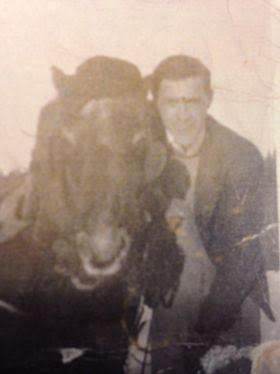
Ice cutting also had domestic purposes. In Central Newfoundland, Corduroy Ponds was an excellent location to cut ice in the winter. Leonard Young, a Mi’kmaq man who grew up near the ponds, kept a dog team and horses in the late 1930s and 1940s (Figure 8). Young would cut timber in the area and his horse would haul sleighs full of wood to the sawmill Young operated on his property. In the winter, Young cut ice blocks from the pond and his horse hauled them back to the sawmill where they were stored in sawdust. Ice blocks were stored here until the summer where they were dug out of the sawdust and delivered to customers in Grand Falls Windsor. Young supplied ice blocks to households as some families in town were still using ice chests.


Figure 8: Leonard Young with his horse, unknown date. Image courtesy of Corey Sharpe.

Special thanks to Andrea O’Brien, Robert Burgess, Clifford George, Albert Legge, Corey Sharpe, and Doug Wells for providing us with many memories, details, and photographs about ice cutting and salmon fishing in Newfoundland.


Cited:

Barras, Maryssa., and Dale Gilbert Jarvis
2021 Burgess Property, Whiteway, NL: Site and Building Survey. Heritage NL Fieldnotes Series, 015, February 2021. https://heritagenl.ca/wp-content/uploads/2021/03/015-Burgess-Property-Whiteway-NL-Site-and-Building-Survey.pdf

The ICH Blog 
2021 What Did You Do with Sawdust in Whiteway?
http://www.ichblog.ca/2021/02/what-did-you-do-with-sawdust-in-whiteway.html

Wells, Doug
2014 Putting Up Ice: Beaver Pond: A Municipal Heritage SIte in Harbour Breton. Intangible Cultural Heritage Update, Number 053 August-November 2014. https://collections.mun.ca/digital/collection/ICH_Update/id/469/rec/1


Friday, February 11, 2022

Living Heritage Podcast Ep213 Millinery with Mad Hatter Sara Anne Meyer

Sara Anne Meyer modelling a tricorn fascinator she created.  

In this episode of the Living Heritage Podcast we talk with Sara Anne Meyer about all things millinery! This includes the history of millinery, her interest and background with the craft, and some of the hats and fascinators she has created over the years.

Sara Anne Meyer is a multi-faceted performer, costumer, maker and poet born and raised in the St. John's arts community. She is an avid observer of intangible history and a folklore enthusiast. But above all things, she is mad as a hatter.


###

Living Heritage is about people who are engaged in the heritage and culture sector, from museum professionals and archivists, to tradition bearers and craftspeople - all those who keep history alive at the community level. The show is a partnership between HeritageNL and CHMR Radio.

Theme music is Rythme Gitan by Latché Swing.


Saturday, February 5, 2022

Folklore Photos: Trinity Restoration Project

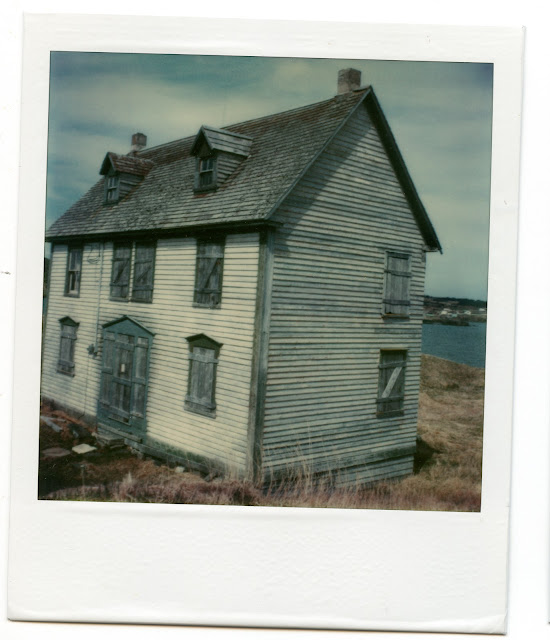
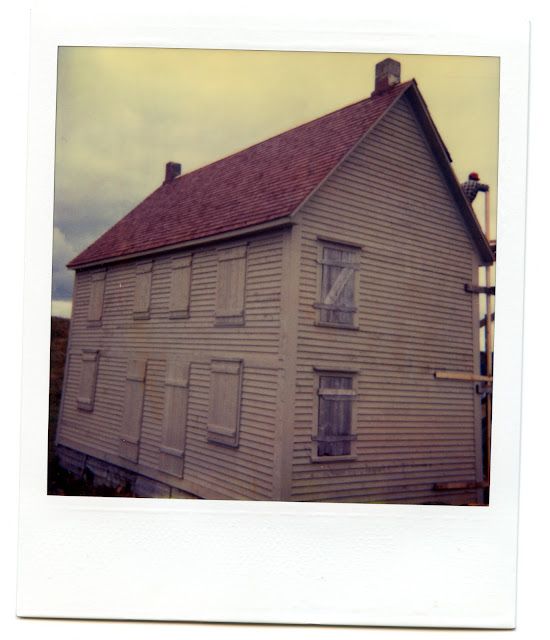
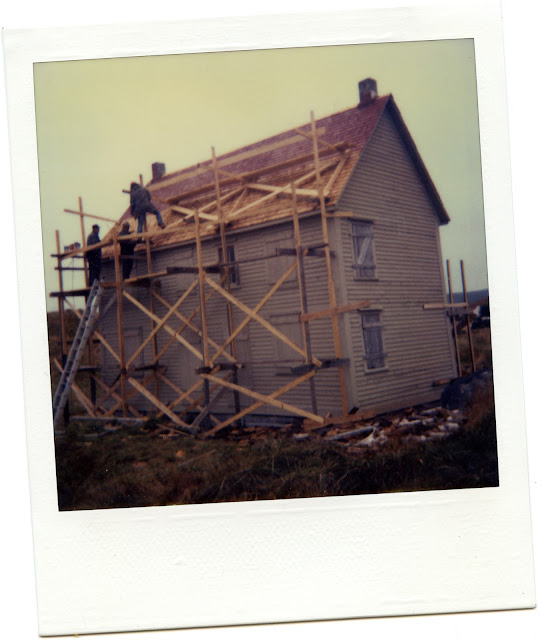
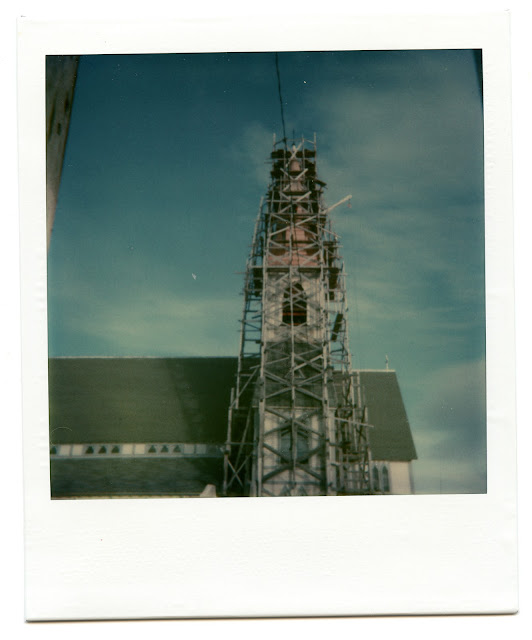
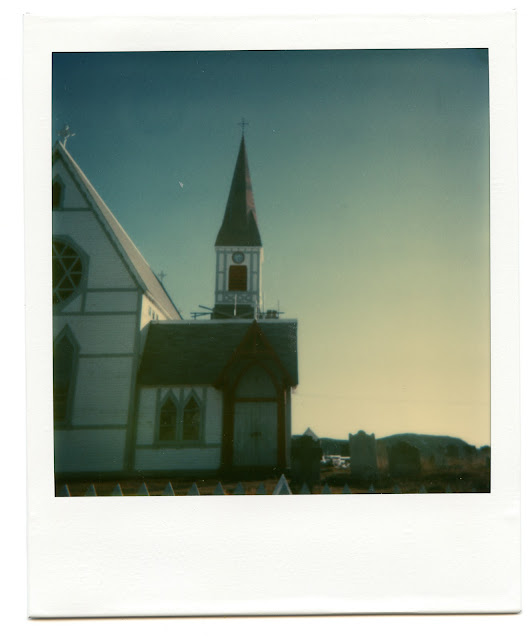
Today’s Folklore Photos come from the Trinity Restoration Project collection currently in the works of being digitized and uploaded to Memorial University’s Digital Archives Initiative. Trinity, a community located in Trinity Bay, has a long history associated with fishing beginning with the migratory fishery. This led the community and its surrounding areas to become important fishing and mercantile communities, eventually leading to settlement starting in the eighteenth century. There have been many projects in the community carried out to preserve and restore its cultural heritage, such as the Trinity Restoration Project. This project featured the restoration of dozens of buildings, primarily household dwellings, throughout the community in 1979 and into the early 1980s. These Folklore Photos highlight just one of the many building restorations under this project.


These scanned polaroid photographs are of an abandoned two-and-a-half storey residential building originally owned by a gentlemen documented as Mr. R. Tibbs. The date of construction is unknown, however in 1979, the structure was owned by Peter Blodgett. The Trinity Restoration Project provided the opportunity to restore this property from its state pictured above in 1979 where the once vibrant paint was fading and the front doors and windows were all boarded up.


A lot of work needed to be done! In 1980, the original roof shingles were removed and replaced. Similarly, the old clapboards were replaced and given a new coat of paint. This building is one of the several dozen that underwent varying degrees of restoration thanks to the Trinity Restoration Project.


The scanned polaroid photographs from the Trinity Restoration Project are in the process of being uploaded to Memorial University of Newfoundland’s Digital Archives Initiative (DAI). The full collection uploaded thus far is available online at:


https://collections.mun.ca/digital/collection/ich_en/search/searchterm/Trinity/field/subcol/mode/all/conn/and/cosuppress/.